

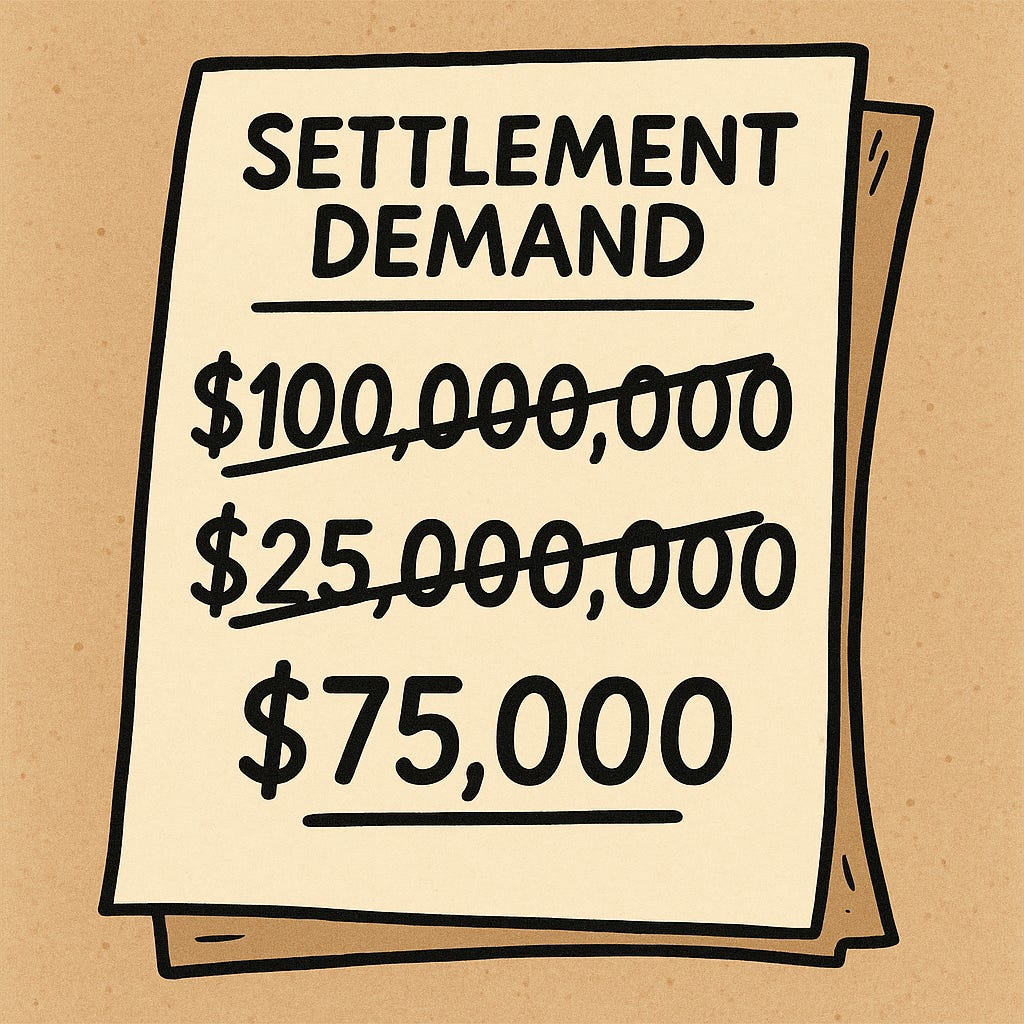
Most plaintiffs’ lawyers are allergic to giving real opening demands. Instead, they insist both parties must perform the scripted “dance.” The dance is predictable and, frankly, dumb: plaintiffs demand 20 times their case’s value, defendants counter with nuisance money, and inch by inch, a deal supposedly gets done. Whether these lawyers believe their own justifications doesn’t matter—this approach is sabotaging negotiations.
Why the Opening Demand Matters
The opportunity to frame settlement negotiations with a thoughtful opening demand is the most powerful tool in any negotiation. Here’s why most lawyers waste it:
First, defendants often haven’t calculated your case’s true value until negotiations begin. A well-founded opener anchors those discussions in your favor. Second, you’re providing crucial information to the lawyers—both outside counsel and in-house—who must report up the chain. Help them manage expectations, and you dramatically increase the odds of reaching a deal. Third, if you hate inefficiency as much as I do, you’ll immediately know whether settlement talks are worth pursuing.
The Inconvenient Truth
So why do plaintiffs’ lawyers squander this advantage? Two related reasons that we’re not supposed to admit:
First, like their defense counterparts, most plaintiffs’ attorneys haven’t done the work to determine their case’s actual value. Second, and this is the real issue, is that many don’t fully believe in their cases. They adopt a “get the other side as high as possible and take whatever deal emerges” mindset. We see this constantly in mass torts, where entire groups of lawyers have zero intention of ever taking a case to trial. Defendants know all too well that they’re working against a bluff with those firms.
My Approach
I believe plaintiffs’ lawyers should be clear, direct, and principled in opening demands. Rather than the traditional dance, I try to establish realistic brackets that frame productive negotiations.
The conversation typically sounds like this: “We should mediate, but only if we’re on the same page about value. I think this case settles somewhere between $300 million and $500 million. If you’re in that range, let’s see if we can get a deal done. If not, let’s beat each other up a bit more in court and then see where we’re at.”
Sometimes I’ll be even more specific about where within that bracket I expect to land, but the goal is giving everyone enough information to determine whether talks are worthwhile without coming across as inflexible. (Of course there are other times when my clients have no flexibility. If that’s the case, I find it best to simply tell the other side what the price of a settlement is so they can make an up or down decision.)
The Reputation Problem
Many readers are shaking their heads, and for good reason. Negotiations don’t happen in a vacuum—negotiators bring personal experience and industry norms to the table. Anyone who’s bought a used car understands this. You see the sticker price knowing you’ll get a “discount.” But think about negotiating the price on something in the frozen section at Trader Joe’s—no one would dream of asking for money off the posted price.
How do we become more like Trader Joe’s and less like a used car lot?
The easiest path is reputation. The first time you tell defense counsel “I think we’re looking at $300 million to $500 million,” they may not believe you’re serious about those parameters. They’ll assume you’re willing to go significantly lower and that you’re doing what everyone else does—floating unrealistic ranges.
But you only need to reinforce your approach once. After that—whether in the same case or years later—they understand you’re providing genuine boundaries for productive discussions, not arbitrary starting points for the traditional dance.
Building Credibility
Mediators help enormously here. Even when negotiating with new counsel, if a mediator understands your style, she can communicate that you set realistic parameters rather than inflated openers.
It’s also useful to “lock in” positions publicly. We do this constantly in class actions. Through our writing, speaking, court papers, and even music videos, we’ve made clear we’ll never consider illusory settlements. When defendants pitch coupon deals, reversionary funds, or weak notice programs, we simply point to our public statements. Discussions on these non-starters end quickly.
Flexibility Within Framework
Some might think even this bracket approach is too rigid. Good negotiators, they’ll argue, listen to the other side’s needs and interests. Of course that’s correct.
Setting realistic parameters doesn’t mean shutting out the other side. My $300 million to $500 million range might rest on certain assumptions—the scope of release they want, expectations about confidentiality, or timing considerations. If those assumptions prove wrong, I’m happy to listen and adjust the framework accordingly.
Other times defendants point out facts I got wrong. In a class action where I estimated 500,000 class members, a defendant demonstrating the actual class was a fraction of that size would obviously prompt a very different range.
The Bottom Line
The negotiation dance isn’t just inefficient—it’s counterproductive. When you establish realistic brackets based on actual case value, you frame discussions around genuine settlement possibilities rather than arbitrary multiples.
Most importantly, you signal that you’ve done your homework and believe in your case—while remaining open to productive dialogue. That credibility becomes your most valuable asset in every negotiation that follows.
Practical and concrete advice—thank you for posting this.
Very interesting read, Jay. Have you read Bill Reid's new book, "Fighting Bullies: The Case for a Career in Plaintiffs' Law?" Interested to hear your thoughts.